
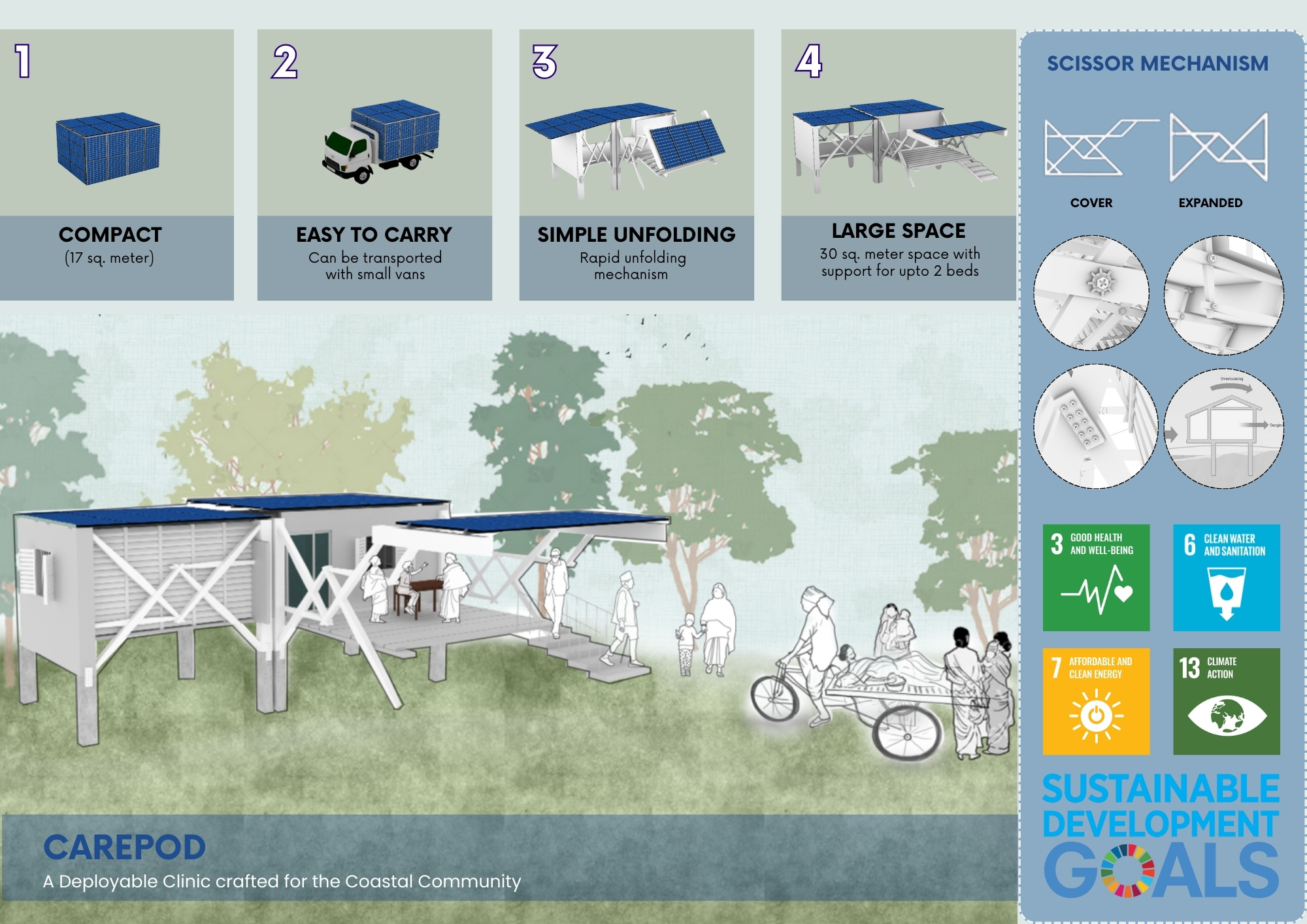
Over 43 million people in Bangladesh live in the coastal areas of the country. The entirety of coastal Bangladesh is under 10 meters in elevation, which increases its exposure to coastal floods and other climatic disasters. Studies show that a person living in coastal areas is 5 times more likely to be exposed to disasters than a person living on the mainland. After a flood or disaster occurs, injuries and the deaths of thousands, as well as the rapid spread of water-borne diseases, become prevalent. During this period, traditional healthcare becomes inadequate and nonfunctional as the structure becomes water-clogged and the power supply gets disrupted. Demand for treatment rises exponentially, and moreover, the lack of transportation makes it difficult to access emergency healthcare. As a result, these people lack healthcare when they need it the most.
We propose Carepod- a deployable, disaster-resilient clinic crafted for the coastal community. It can be kept in a compact state before deployment, which is easy and suitable for transportation to the target location. There, it can be rapidly unfolded, and in the deployed state, it is as good as any other community clinic.
scissor mechanisms will be used for deployment and contraction. Stilts will be used for minimal disruption of natural habitats as well as to ensure a minimal carbon footprint.
We have also thought about some other features like water gutters for rainwater harvesting, which is a common practice in the coastal area. The solar panels can be handy during power outages owing to the turbulent weather and insufficient power supply to the coastal areas. Also, universal accessibility is something that is often forgotten in rural projects, but not in this case.
Color bond ultra steel can be used for roofs, walls, and downpipes. The reverse osmosis Tetra Filters should be used in this case, made by Tetra, who also happens to be one of our key advisors! In coastal areas, salinity is a huge issue. So pure drinking water is actually as vital and scarce as medicines. That is why, even in the existing model, the existing community clinics sell drinking water at 2 tk per liter. So we aim to focus there too.
We aim to conform to a marketing policy that blends the traditional below-the-line and above-the-line strategy with modern TTL(through-the-line) strategies. We will partner with banks and other corporate houses that have invested in similar projects as part of their CSR-corporate social responsibility activity. IDCOL has already taken the initiative to establish 18000 solar-powered community clinics. It has also been a very long time since Standard Chartered Bank focused on coastal development and started investing there heavily. These could all be our potential partners.
Our sales channel will be predominantly reliant on integration into government projects, as coastal healthcare and community clinics are primarily provisioned by the government. We will use the government apparatus for social welfare and public health-related promotions. We will invite the government for collaboration by promoting the positive impacts we can have.
However, community clinics are managed and maintained by the local community. So we will also aim to fetch at least one-tenth of our sales fromthe B2C channel.
All of these marketing, collaboration, and negotiation will be based on the positive impact we can bring into the lives of the impoverished, underprivileged coastal people. We will contribute to both mitigation and adaptation. By providing a substitution for in-situ construction, we save the coastal environment from the infamous, corrosive waste generated during construction. In normal times, our structures co-exist more with nature and obstruct natural processes far less than permanent structures. But that is just the beginning. In the toughest of situations, we contribute to adaptation to inevitable disasters. Our carepods can be shifted easily to places of population influx during disasters and thus can save people as well as their own durability from the wrath of nature.
The carepods are reliable during normal times and resilient, even during the worst weather.
Carepods are holistic solutions for the people living in coastal regions. Carepods provide opportunities for employment, treatment and environmental sustenance. Every community clinic provides a job prospect for 15-20 coastal residents. The carepods provide basic healthcare facilities, just like community clinic effectively does. It is not intended to tinker with the healthcare-providing facility. Rather, our team focuses on making the healthcare structures less harmful and more responsive to nature. This is how we aim to support and improve the lives of climate refugees.
Of course, it’s a very bold dream that must be backed up by a very passionate team. Our team behind this idea and vision of Carepod is a multi-disciplinary team consisting of individuals from different disciplines. We have students from the Department of Architecture, Civil Engineering, Computer Science and Industrial & Production Engineering.
This cross-disciplinary team is what fuels our aspirations, and we have been busy for quite a long time, we have been awarded 50,000 BDT by ICCCAD initially for further rectification of our idea and market research. We have collaborated with Tetra for 6 months now, learning how to survive in a very dynamic, multi-objective circumstance. We know that this is just the beginning, and we have a long way to go.
But that is exactly what inspires us more! Carepods have the potential to have a massive impact on the lives of people, covering crucial SDGs like 3,6, 7, and 13. We aim to provide healthcare facilities to that portion of our population, who are the most unprivileged, deprived and destitute.
 Carepod_Presentation.pdf